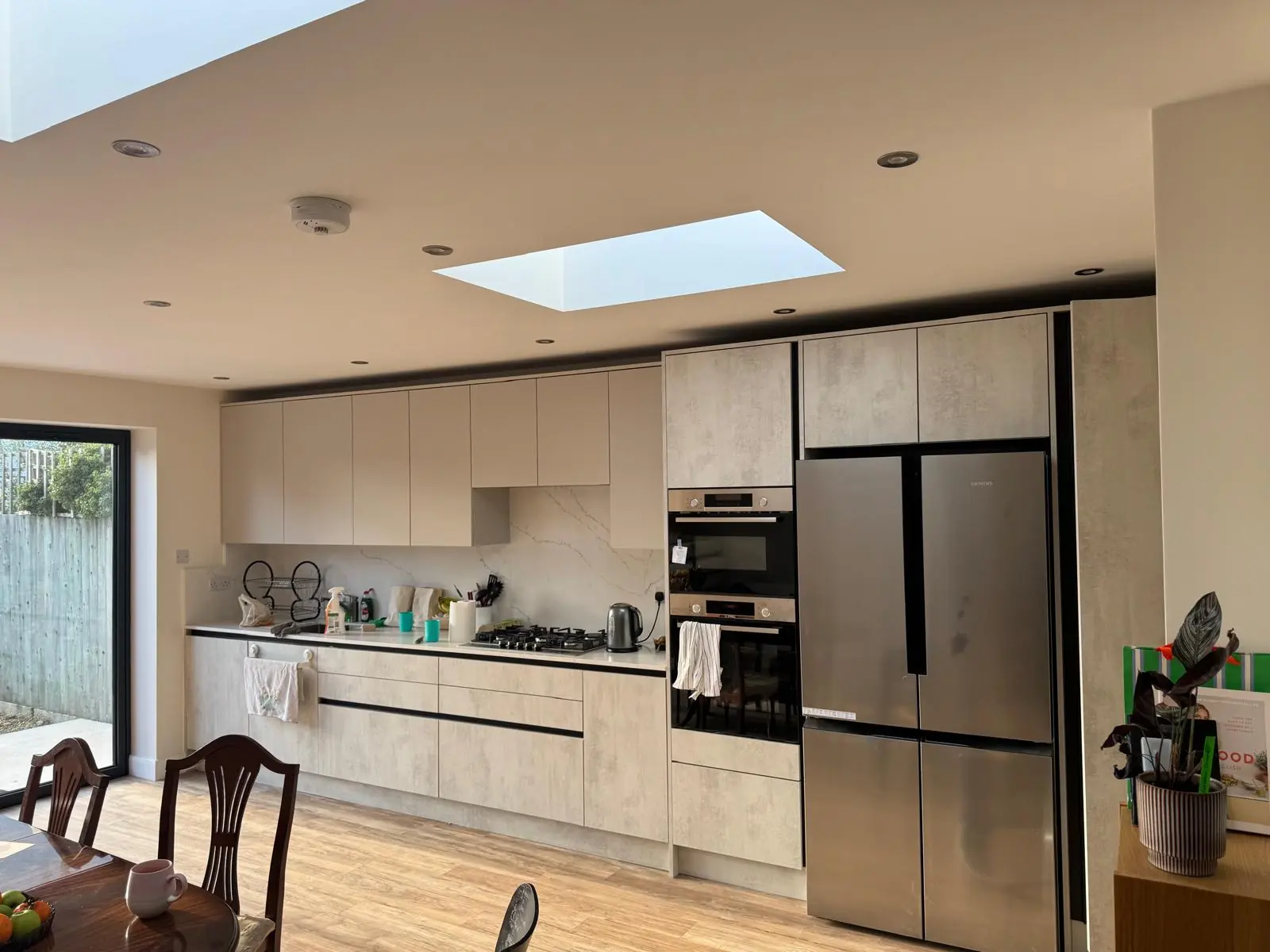
1. The “Square Footage” Trap (And why it’s costing you)
I’m going to be blunt: the obsession with “more square metres” is ruinining some perfectly good London homes. Every week, we see homeowners who think that pushing the back wall of their house out by an extra three metres is the magic fix for a cramped lifestyle. It isn’t.
In fact, if you aren’t careful, you’re just paying £50k+ to create a “dead zone” in the middle of your house.
Here is the reality of the trap. When you build a massive, deep extension without a proper plan for light, the original middle room of your house—the one that used to be a cosy lounge—suddenly becomes a dark, windowless corridor that you only use to get to the new kitchen. You’ve added floor space, sure, but you’ve effectively “killed” a third of your ground floor.
At Force Builders, we tell our clients that it’s not about the footprint; it’s about the flow. We’d much rather build a slightly smaller, “smart” extension with clever roof lanterns, vaulted ceilings, or strategic glazing that actually makes the entire house feel bigger.
Think about it: Would you rather have a 40sqm room that feels like a gloomy basement by 3 PM, or a 30sqm space that’s flooded with natural light and makes your existing living room actually usable again?
Don’t let a surveyor’s “price per square foot” chart dictate your home’s soul. A big house that’s dark and drafty is just a big mistake. We’re here to build spaces that earn their keep, not just spaces that look impressive on a floor plan but feel hollow when you’re actually trying to live in them.
2. The Thermal Envelope: Why your 2026 extension shouldn’t feel like a tent
We’ve all been in that one house. You know the one—the owners spent a fortune on a massive bifold door and a designer kitchen, but the moment the sun goes down in November, you have to put on a puffer jacket just to make a cup of tea. That is the result of a “thin” build. At Force Builders, we call these ‘glorified tents,’ and in 2026, there is absolutely no excuse for them.
The “Thermal Envelope” sounds like a fancy architectural term, but it’s actually dead simple: it’s the continuous layer of protection that keeps the heat you’ve paid for inside your walls. If there’s a gap in that envelope, you might as well be heating the street.
Why “Meeting Building Regs” is the bare minimum
One of the biggest mistakes homeowners make is telling their builder: “Just make sure it passes Building Control.” Here’s the reality—Building Regulations are a C-grade. It’s the lowest legal standard you’re allowed to build to. In the climate of 2026, with energy prices doing what they do, building to the “minimum” is a recipe for a cold, damp home in five years.
- The PIR Problem: We don’t just “stuff” some Celotex between the rafters. We focus on thermal bridging—those tiny gaps in the structure where heat escapes like air from a punctured tyre.
- Airtightness vs. Ventilation: A house needs to breathe, but it shouldn’t “leak.” We use high-spec vapour barriers and tapes that 90% of budget builders won’t bother with because “they take too long to install.”
- The Glazing Trap: Those massive glass walls look stunning on Instagram, but glass is essentially a hole in your thermal envelope. We prioritise high-performance U-values (the measure of heat loss) so your view doesn’t come with a side of frostbite.
“I’ve walked onto too many sites where the insulation has gaps big enough to fit a fist through. If you can see daylight through your ‘insulated’ roof before the plasterboard goes up, your builder is failing you.”
— Senior Site Manager, Force Builders
What we do differently
When we’re building an extension in Kensington or Richmond, we treat the thermal envelope as the most important part of the job. You can change your kitchen tiles in ten years, but you can’t easily change the insulation inside your walls. We focus on:
- Overlapping Insulation: No gaps, no cold spots, no condensation issues down the line.
- High-Spec Sub-floors: Most people forget that the cold comes up from the ground. We over-spec our floor insulation so you don’t get that “icy feet” feeling on your new tiled floor.
- Future-Proofing: Building a “warm shell” now means you can install a smaller, cheaper heating system (like an air-source heat pump) later because the house actually holds its temperature.
It’s not the sexiest part of a renovation—no one ever threw a dinner party to show off their 150mm high-performance floor insulation—but it’s the bit that makes your house a home. Don’t build a tent. Build a fortress against the British winter.
3. “Broken-Plan” vs. the Echo Chamber
Let’s be honest: everyone’s seen the Pinterest “open-plan dream”. It photographs brilliantly — huge kitchen, massive island, no walls anywhere. But there’s a side of it no one really talks about until you’re living in it… and that’s the noise.
Put a whole family into one open 50m² space and you’ll notice it within a week: the noise doesn’t have anywhere to go, so it just spreads. Someone hits “blend” and it’s like a siren in your skull. The dishwasher hums away in the background, and suddenly you’re raising your voice just to have a normal conversation. Try taking a Zoom call while someone’s making lunch and you’ll be apologising on mute every thirty seconds.
That’s why we’re seeing more and more people fall out of love with open-plan once the novelty wears off. In 2026, the biggest complaint we hear isn’t “we need more space” — it’s “we can’t get any peace.” So we’re steering clients towards broken-plan layouts. Not a return to cramped, dark rooms, but a smarter setup: you keep the light and the open feel, while adding just enough separation to stop the whole house behaving like one big speaker.
The “echo chamber” problem is real
Hard floors, big bifolds, high ceilings… it looks premium, but acoustically it’s chaos. Add kids, a dog, or just normal daily life, and an open-plan extension can start echoing within ten minutes.
So we’re now doing things like:
- Internal Crittall-style partitions
You still get the light and that clean, modern look — but you can actually close a door when the dishwasher kicks in or someone’s on a call. - Half-walls and little nooks
Instead of one big square room, we build in alcoves and corners. Suddenly you’ve got a spot for a desk, a reading chair, or a quiet corner that isn’t right in the middle of kitchen traffic.
Why the “big box” approach is a lazy design shortcut
Knocking a wall down is easy. Designing a space that works for real life is the hard part.
Because in 2026 your house isn’t just a house. It’s an office, a school, a gym, and a cinema — sometimes all in the same day. And if you don’t build in some physical separation (a bookshelf wall, a change in floor level, a partition, even a subtle layout shift), there’s a good chance you’ll end up resenting that expensive new extension by next Christmas.
Bottom line: don’t build for Instagram. Build for the way your family actually lives — and the amount of noise they make. You’ll be glad you did the first time you’re trying to read in the lounge while someone’s washing up ten feet away.
4. The Hidden Costs of “Tight Access” Construction
If you’re building an extension in a place like Kensington or Fulham, you aren’t just fighting the weather — you’re fighting the street itself. This is the part of the quote that people always try to skim over, but in London, “access” is the difference between a smooth job and a financial train wreck.
We’ve had sites where every single brick, bag of sand, and steel beam had to be carried by hand through a narrow Victorian hallway because there was no side gate. That’s not just a bit of extra work; it’s a logistical puzzle that changes the entire pace of the build.
The “Skip” Nightmare
In Richmond or Putney, you can’t just plonk a skip on the road and forget about it. You’re dealing with permits, suspended parking bays (which cost a fortune daily), and neighbours who will be on the phone to the council the second a speck of dust hits their Porsche.
- Muck away: If we can’t get a grab lorry close to the dig, we’re talking about hand-loading or using micro-diggers that can fit through a standard door. It’s slow, it’s messy, and it’s expensive.
- The Steel Problem: Try getting a six-metre goalpost steel into a terraced garden without a crane. Sometimes we have to design the structure in smaller sections just so we can physically get it to the back of the house.
Why transparency matters here
A lot of builders will give you a “low-ball” quote and then hit you with “unforeseen access costs” three weeks in. We don’t play that game. If we have to carry three tonnes of earth through your front door, we’ll tell you exactly how long it’ll take and what it’ll cost before we even pick up a shovel.
Bottom line: Don’t just look at the price of the bricks. Look at how those bricks are actually going to get into your garden. In London, the “how” is often more expensive than the “what”.
5. Material realities: why we’re choosing timber and glass over basic brick
The UK still has this stubborn belief that “proper” building means solid brick. If it’s not heavy masonry, some people assume it’s flimsy or second-rate. But in 2026, defaulting to plain brick for a London extension is often just… the path of least resistance. It’s slow, it’s labour-heavy, and it’s not automatically the best option for warmth and comfort anymore.
At Force Builders, we’re reaching for high-spec timber framing and specialist glazing more than ever — not because we’re chasing trends, but because it’s a smarter way to build when you’re tight on space, tight on time, and you want the job done properly.
The “wet trade” problem
Brickwork is a wet trade. That means you’re constantly negotiating with London weather, and you can lose weeks waiting for things to dry before you even think about plastering and second fix.
With a timber frame, we can get the structure up quickly, get it watertight, and hand over to the internal team much faster. In real terms, that can be the difference between you having your kitchen back in three months instead of six.
Light is a material too
In a typical London terrace, natural light is worth its weight in gold. Build an extension with chunky brick piers and heavy openings, and you’re basically paying to create more shadow.
That’s why we’re pushing solutions like:
- Structural glazing and slim-frame systems
Where it’s viable, we’ll use glass in a way that opens the room right up, or go for slim-profile aluminium frames that keep sightlines clean. The garden stops feeling like something you look at through a “hole in the wall” and starts feeling like part of the space. - Timber cladding and modern, breathable renders
These systems can deliver excellent insulation with slimmer wall build-ups than traditional double-skin brickwork. You often gain usable internal space simply because the walls aren’t eating up the footprint.
Don’t build a fortress — build a space
Some clients worry timber will feel “flimsy”. Honestly, that’s outdated thinking. Modern engineered timber frames are incredibly rigid, and they’re brilliant for creating the wide, open spans people want — often with less visual clutter than oversized steels running through the ceiling.
Bottom line: brick absolutely has its place, especially where you need to match the existing street scene. But don’t let a builder steer you into it just because it’s “what we’ve always done”. The best extensions in 2026 use the right tool for the job — not just the heaviest one.
6. Building for the next decade, not just the next year
There’s a huge difference between a house that looks good on the day the builders leave and a house that still feels right five years later. In 2026, it’s incredibly easy to get distracted by the “surface” stuff—the high-end worktops, the trendy taps, or the latest smart home gadgets. But if you’ve skimped on the core of the build to afford a fancy kitchen, you’re going to regret it.
At Force Builders, we try to push our clients to think about the “hidden” value. It’s about building a space that doesn’t just add value to your house on paper, but actually changes the way you live every day.
The “Future-Proof” mindset
Building an extension is a massive upheaval. If you’re going to do it, do it once and do it properly. That means thinking about things that aren’t exciting to talk about now, but will be vital later:
- The “What If” layout: Can this space adapt? Maybe it’s a playroom now, but in five years it might need to be a quiet office or a guest suite. We design with that flexibility in mind.
- Maintenance reality: We’ve seen too many extensions where the materials look “tired“ after just two winters. We choose finishes and structural details that actually weather the London air without needing a full refurb every three years.
- Energy independence: With the way energy costs are going, your extension should be helping your house’s overall efficiency, not dragging it down.
It’s about more than just “finishing”
We don’t just want to hand over a set of keys and disappear. We want to know that when the first big storm hits or the temperature drops to zero, your new space is the warmest, quietest, and most comfortable room in the house.
Bottom line (the real one): A new extension is probably the biggest investment you’ll make in your home. Don’t let it be a “quick fix” or a “cheap add-on.” Build something that feels like it was always meant to be there—something that’s built for the long haul.
FAQ
1) What is the “square footage trap” in a London extension?
It’s when you build a deep, oversized extension just to add metres, but you don’t plan properly for daylight and layout flow. The result is often a dark “dead zone” in the middle of the house — extra floor area that feels unusable.
2) Is a smaller extension ever better than a bigger one?
Yes. A well-designed 30m² space with good daylight and smart layout can feel bigger and work better than a gloomy 40m² “big box” that kills the original middle room.
3) What does “flow” mean in extension design?
Flow is how you move through the space and how rooms connect in real life — not just on a floorplan. Good flow keeps the original house usable, avoids dead corridors, and makes the extension feel integrated rather than bolted on.
4) What is a “thermal envelope” and why does it matter?
The thermal envelope is the continuous layer that keeps heat inside your home — insulation, airtightness layers, and correct detailing. If it’s broken (gaps, cold bridges, leaky joins), you’ll lose heat fast and end up “heating the street.”
5) Isn’t “meeting Building Regulations” enough?
It’s the legal minimum, not the best standard for comfort and running costs. Building to “just pass” can leave you with cold spots, condensation risk, and a home that feels draughty within a few winters.
6) What is thermal bridging and why is it a big deal?
Thermal bridging is where heat escapes through small gaps or structural elements that bypass insulation. Even small bridges can create cold spots and condensation issues — especially in roofs and junctions.
7) Can a house be airtight and still “breathe”?
Yes — airtightness and ventilation are different things. A good build stops uncontrolled leaks, then uses proper ventilation solutions so the home stays healthy without draughts.
8) Are big glass walls a problem for warmth?
They can be, if you treat glazing like decoration instead of performance. Glass is effectively a weak point in the thermal envelope, so U-values and specification matter if you want comfort as well as views.
9) What’s the downside of open-plan living in 2026?
Noise. Open-plan often turns into a “speaker box” — kitchen sounds travel everywhere, and you lose privacy and quiet zones. That’s why more people experience “buyer’s remorse” once daily life kicks in.
10) What is “broken-plan” and how is it different from open-plan?
Broken-plan keeps the open feel and daylight, but introduces smart separation: partitions, half-walls, nooks, changes in level, or built-in features that create zones for different uses.
11) Will broken-plan make my home feel smaller or darker?
Not if it’s designed properly. The goal is to keep sightlines and light while reducing noise and creating usable pockets — so the space feels more comfortable, not boxed in.
12) What are Crittall-style partitions and why use them?
They’re slim, glazed internal partitions that let light travel while giving you the option to close off noise and activity. You keep the look, but gain control over sound and privacy.
13) Why do “tight access” sites cost more in London?
Because getting materials and waste in and out can become the job. No side access often means everything is carried through the house, skip permits are expensive, and logistics can slow the whole programme.
14) What’s the “skip nightmare” and why should I care?
In areas like Richmond or Putney, you can’t just drop a skip on the road. Permits, suspended bays, neighbours, and council rules can add real daily costs — and delays.
15) What is “muck away” and why does it blow budgets?
It’s removing soil and waste from the dig. If machinery can’t reach the back, it can mean hand-loading, micro-diggers, and slower removals — which adds labour and time.
16) Why do steel installs get complicated on terraced houses?
Large steels often can’t be carried through narrow hallways or tight gardens without a crane. Sometimes the structure needs redesigning in smaller sections just to physically get it into place.
17) Why are timber frames and specialist glazing becoming more popular than brick?
Speed and performance. Brick is slow (wet trade + drying time). Timber frames can go up faster, get watertight quickly, and allow efficient wall build-ups that can improve insulation and space.
18) Does timber feel less “solid” than brick?
Modern engineered timber frames are rigid and strong. The “flimsy timber” idea is outdated — and timber can also enable wider spans with cleaner ceilings and fewer bulky structural compromises.
19) Is brick still worth using sometimes?
Yes — especially when you need to match the existing façade or street character. The point is: brick should be a considered choice, not the default because it’s familiar.
20) What does “future-proofing” an extension actually mean?
Designing for change and longevity: flexible layout (“what if this becomes an office/guest room”), durable materials that don’t look tired after two winters, and a warm, efficient build that supports lower-cost heating upgrades later.
21) Why should I prioritise “hidden value” over finishes?
Finishes can be swapped. Insulation, airtightness, structure, and detailing are much harder and more expensive to change later. If you get the core right, the home stays comfortable and cheaper to run.